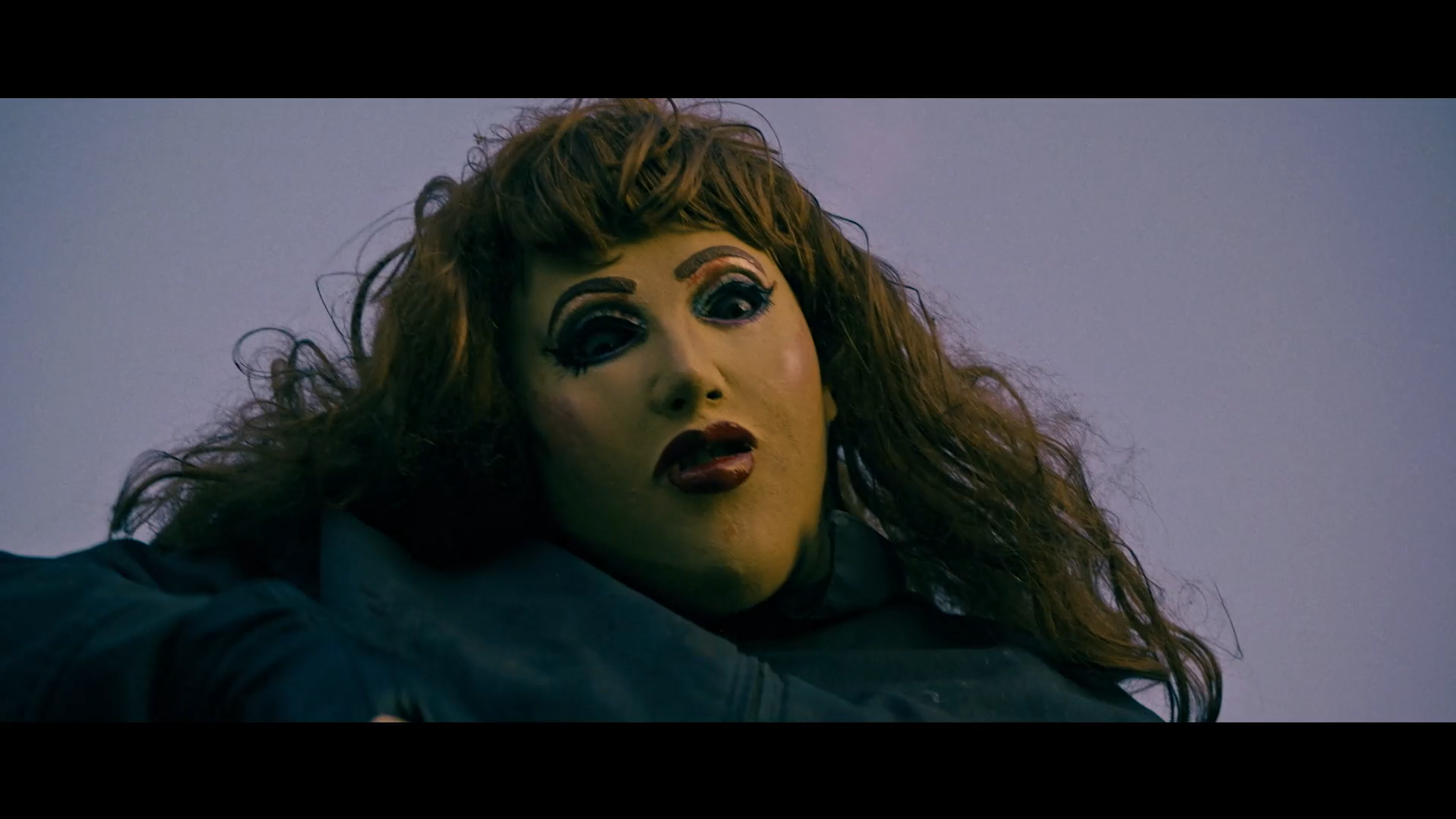
This Tempting Madness Mixes Body Horror With A Slow Psychological Burn
A woman wakes up in a hospital bed with a shattered body and a hole where the last six months used to be. Her husband has been arrested for trying to kill her. Somebody in her life did something terrible, and the only person who was definitely there, the one witness who cannot be bribed or coached or subpoenaed into lying, is her. She is also the person least able to say what happened.
That is the setup of This Tempting Madness, and it is a good one. Amnesia thrillers have been running that engine since before most of us were born. What makes this one sit differently is a card that arrives in the first minute and then quietly reorganizes everything after it. The movie tells us immediately that it was inspired by a true story.
I got nine minutes with director Jennifer E. Montgomery, which is what a press day gives you, and spent most of it discovering how little of this was invented. According to Montgomery, the dental hardware is real. So are the memory gaps. So is the journal that made the whole thing possible, and it exists because Montgomery talked her best friend into keeping it under slightly false pretenses.
She Kept the Journal Because Someone Asked Her To

Montgomery has said in other interviews that her friend came out of a coma able to hold about sixty seconds at a time. What she told me was the next part of the story, the part where a filmmaker with no intention of filming anything starts nudging a survivor toward a notebook.
“I wanted her to keep the journal just so that she could remember for herself,” Montgomery said. “And the only way that I got her to keep the journal, because she’s very much someone that doesn’t like to do things for herself, but she’ll happily do them for other people. She’s like, well, I don’t need to keep a journal, but if you want to make a movie of it, then I guess I can. And I’m like, OK, yeah, yeah, yeah, keep the journal. And because I’ll make a movie of it. And I did not intend to.”
Sit with that for a second. The document at the center of this film exists because a woman who would not do a thing for her own benefit agreed to do it for her friend’s imaginary project. A year later the memory came back, the notebook was full, and the friend turned around and asked when the movie was getting written.
“At that point, I hadn’t intended, but at the same time, it’s here,” Montgomery said. “And she’s saying, I want you to do this. I worked so hard. You encouraged me to do this. You said you were going to do it. So that’s why I wrote the journal.”
Montgomery is careful about the consent question, and she brought it up before I could. “She didn’t have to dupe me into it by any means. It was simply me wanting to make sure that it was a story she really wanted to tell because it’s very personal.”
Your Mind Keeps What It Wants

The film hands you information the same way Mia gets it, which is to say confidently and wrongly. I spent the runtime being sure I had it figured out and then being punished for that roughly every twelve minutes. When I asked how she decided what the audience was allowed to know, Montgomery went somewhere I did not expect, which is straight into how ordinary memory works.
“So memory is such a weird thing,” she said. “Like if you try to even just think back on your own memory, something that is even a strong memory that you think you know everything about, you don’t live it in real time. It’s not every second of what happened. Your mind is remembering what your mind is choosing to hold on to.”
This is not a filmmaker being poetic. It is remarkably close to how memory researchers describe reconstructive memory, where recall is not a literal playback of the past but a reconstruction shaped by stored information, prior knowledge and expectations. Montgomery built her structure on it.
“And when you take just moments of a memory away, or moments of a moment in time away, it changes everything,” she said. “So what you’re seeing is what she remembers, or what her mind is allowing her to remember in that moment. But then when she can remember a little bit more, it’s different. It shifts. And so her mind is conveniently dropping things and forming what it wants to form versus maybe what the reality is.”
Conveniently. That word is doing a lot of work. It turns the mind from a damaged instrument into something with an agenda, and that is where the film stops being a mystery about an assailant and becomes something meaner. We have a whole shelf of movies about being trapped inside someone else’s version of reality. This one traps you inside your own, which turns out to be harder to escape, because there is nobody to run from.
The Screws Were Real

There is a sequence involving dental equipment that made me sit forward, and not in the fun way. I mentioned it to Montgomery mostly as a compliment about staging. She took it somewhere else.
“Oh, yeah, that is real. Her jaw was shattered,” she said. “It was in that whole moment when the screw comes out. That’s something that happened. Like she texts me a picture. She’s like, oh, look, I’m Terminator now, screws are coming out of my jaw.”
The gallows humor is the friend’s, not the film’s, and it tells you something about the person the movie is based on. Montgomery’s point was about the aftermath rather than the injury. “In the movie, it’s a horrifying thing because the process of coming back from that is so painful.”
Horror is fluent in wounds. It is much worse at healing, which is slow, unphotogenic, and full of appointments. A film that finds its most upsetting material in the recovery instead of the assault is doing something the genre almost never bothers to do.
The Phoenix in the Orange Dress

If you have seen the trailer you have seen the orange dress. I assumed it was a stylist’s win. Little did I know, it is a thesis statement.
“It wasn’t just a movie about someone falling,” Montgomery said. “It was a movie about someone rising like a phoenix. And that’s why we have the big orange dress, the fiery looking wing like plume, because we really wanted it to be a phoenix falling and rising from the ashes. And she really chose to do that every day with that physical therapy and all that dental work that was not fun at all to get through.”
Montgomery is direct about why a story like this became a genre picture rather than a drama. “It’s a genre film. And it’s built to be thrilling and, you know, have horror elements, but at the same time, it deals with really serious subject matter in a subversive way.” Horror gets to smuggle. Strange Darling used a fictional true story framing as part of its opening misdirection. Here the claim is load bearing, and the smuggling runs the other direction, with real recovery hidden inside a thriller so that people will actually watch it.
She says that has been landing. “There have been a lot of people that have come up to us after seeing it at the various film festivals that have explained how impactful it was for them because they related to various pieces of it.”
Everyone Is a Suspect and Everyone Is a Person

The film holds its cards until late, and it does it without turning the supporting cast into furniture, which is the usual cost of that structure. Montgomery credits the grind.
“When you’re making a movie, you’re writing it multiple times. You’re writing it as a script. You’re writing it as you film it. And then you’re writing it as you edit it.” She worked through it with editor Kiran Pallegadda, who gets an unprompted endorsement. “Very emotionally sensitive, just going through and trial and erring. And it’s crazy, you change one tiny little thing and the read for audiences is totally different.”
That is the amnesia thriller’s whole problem in one sentence. Every frame is a potential tell, and Kryptic hit the same wall from the opposite side, withholding until the audience floats.
On the ensemble, where nearly everyone appears to be doing something they are not actually doing, she gave the most revealing answer of the interview. “This was a very personal process to me. These are all people I knew well. And these are all people that I wanted to be kind to and service and bring to life.”
People she knew well. Not archetypes, not suspects. The film’s twistiest machinery is populated by her friend’s actual circle, and the instruction she gave herself was to be kind to them while making every one of them look guilty. That is a strange assignment and it explains why the supporting characters keep resisting the shapes the plot wants to press them into.
Montgomery makes her feature directorial debut here, from a script she wrote with cinematographer Andrew M. Davis, who is also her husband. Simone Ashley leads opposite Austin Stowell, with Suraj Sharma, Mojean Aria, Amol Shah and Zenobia Shroff.
This Tempting Madness has been on digital and in select US theaters since 12 June through Vertical. It reaches UK digital platforms today, 10 August, through Plaion Pictures, certificate 15.
What stays with me is not the solution. It is the thing Montgomery kept circling, that a mind protecting itself will edit, and it will edit convincingly, and the person being protected has no way to audit the work. Her friend got most of it back and got a movie out of it. Most people do not get either.